


The February mocks are over. The scripts are piled high. The data is in the spreadsheet.
But as you look at that sea of numbers—4, 5, 3, U—you face a brutal reality: A grade "4" doesn't tell you how to get a "5." It just tells you they aren't there yet.
With only 10 teaching weeks left until the first GCSE exam, you cannot afford to reteach everything. You don't have time for a broad brush revision strategy. You need a laser-scalpel.
The difference between a student scraping a 3 and securing a strong 4 often isn't a lack of knowledge; it’s a lack of precision. And finding that precision is the quickest win you have left.
The "Hidden Mark" Trap: A GCSE Biology Case Study
Let’s look at a classic "Grade Boundary" trap in GCSE Biology: Osmosis.
The Question: "Explain the movement of water in the potato cylinder." (3 Marks)
The Student’s Answer: "Water moves from a high concentration to a low concentration through a semi-permeable membrane."
The Manual Marking Reality: A tired teacher, marking their 60th paper at 11 PM, ticks "0" for the first point and moves on. Why? Because the mark scheme specifically requires the phrase "water molecules" or reference to "water potential."
The Consequence: The student thinks they don't understand Osmosis. The teacher thinks the class needs a full revision lesson on transport in cells.
The student understands the concept perfectly but failed the scientific literacy check. They are describing the phenomenon correctly but using imprecise language.
Why Manual Question Level Analysis (QLA) Fails to Spot Learning Gaps
Spotting that one missing word across 150 scripts is impossible for a human to do at scale.
When you are manually entering data for Question Level Analysis, you typically record the score: Question 4 = 0/3.
This data is useless for intervention. It tells you that they failed, but not why.
- Did they fail because they don't know what a membrane is? (Conceptual gap).
- Did they fail because they missed the word "molecules"? (Precision gap).
If you act on the data, you end up reteaching the whole topic of Osmosis to everyone. You waste a precious revision lesson covering content they already know, just to fix a vocabulary error they could have corrected in 5 minutes.
The Solution: Automated Intervention Strategies using Vertical AI
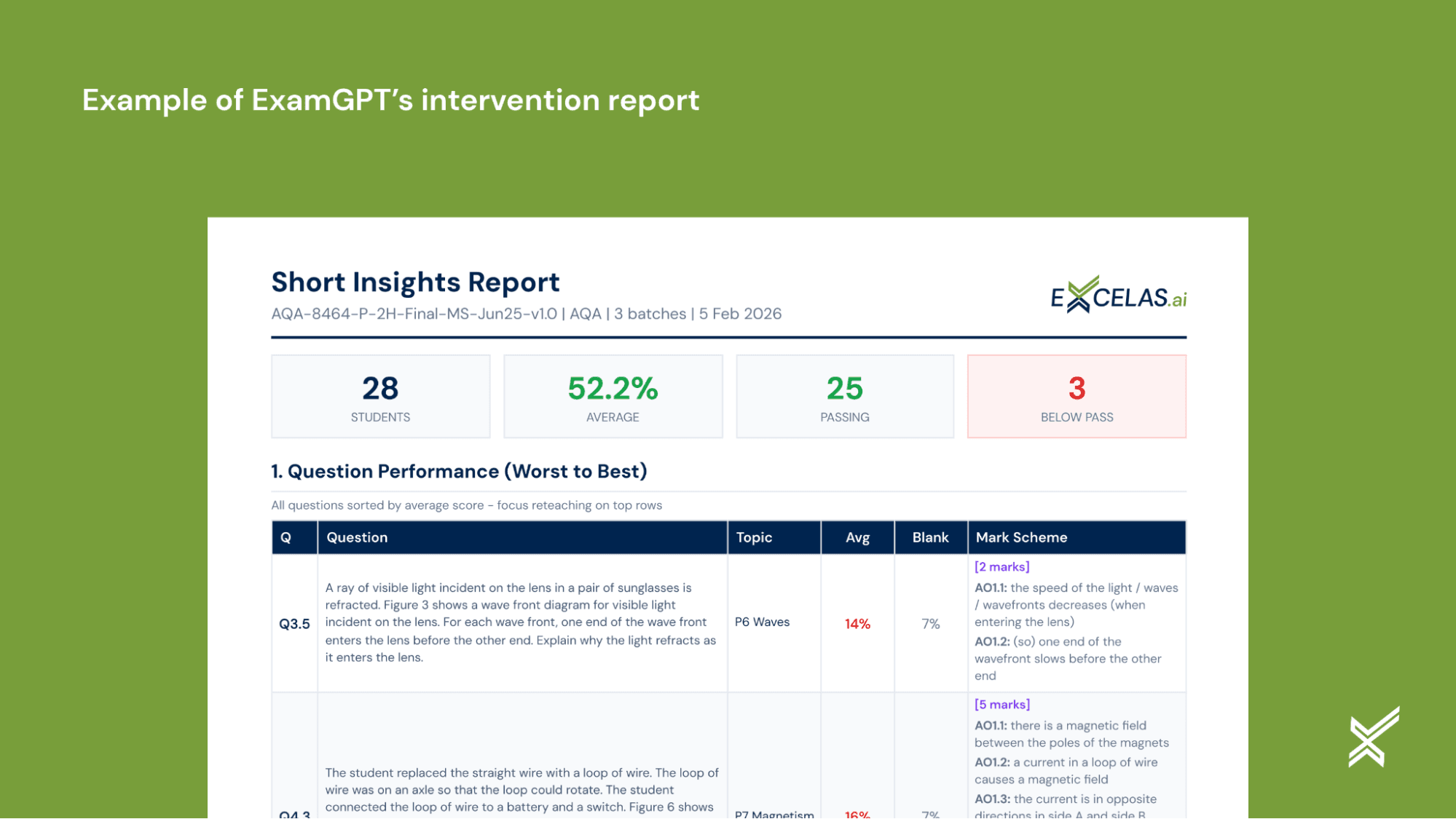
Example Intervention Report
This is where ExamGPT turns your mock data into actionable grades.
Because our Vertical AI engine doesn't just "mark" the paper—it reads the logic—it spots the pattern that human eyes miss.
The ExamGPT Insight:
"Flagged Pattern: 12 students in Class 11B scored 0 on Question 4. Logic implies correct conceptual understanding of diffusion gradients, but failed to specify 'water molecules'."
The Intervention: Instead of a whole lesson on Osmosis, you do a 5-minute starter on Monday morning regarding Scientific Precision: "Class, look at these two sentences. 'Water moves' is vague. 'Water molecules move' is precise. In science, we don't just describe what happens; we describe the mechanism. Let's practice upgrading our language from 'description' to 'explanation'."
You have just saved a lesson and helped them gain marks. That is teacher workload reduction in action.
Whether it's the 'Osmosis Trap' in Biology or 'Refraction logic' in Physics, the principle remains the same: find the specific gap, fix the grade.
The "5 Grades" Math
Why does this matter? Because GCSE grade boundaries are razor-thin.
- Moving a student from a Grade 3 to a Grade 4 often requires just 2-3 extra raw marks across a paper.
- Moving from a Grade 8 to a Grade 9 can be a matter of technical precision.
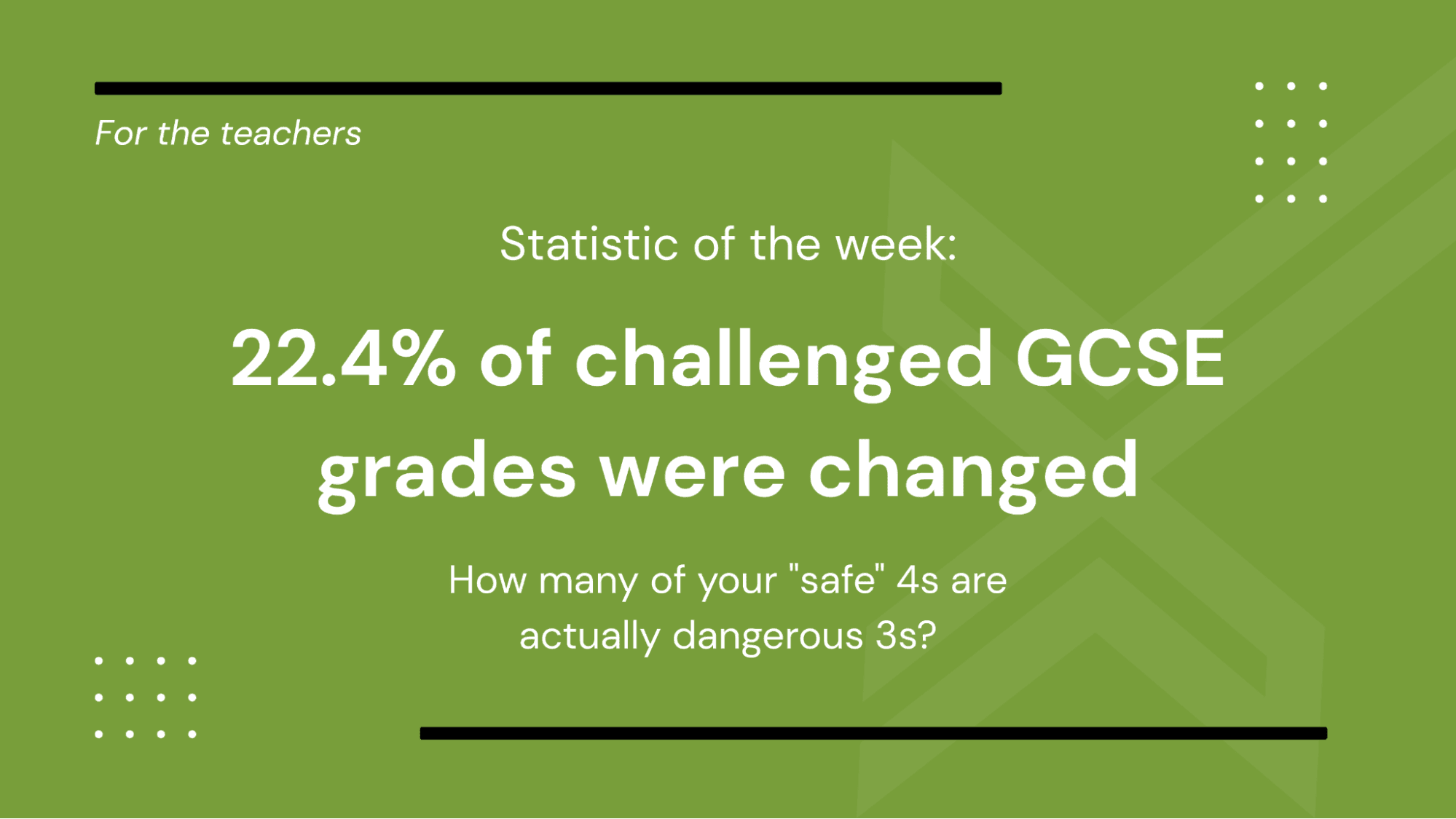
The margins are so tight that human error frequently bridges the gap. In 2024, 22.4% of challenged GCSE grades were changed, often by just a single mark. That single mark is the difference between a 'good' pass and a retake.
This is where the math works in your favour:
If you can use data-driven intervention to find just one recurrent, fixable error like the "Osmosis Trap" across a class of 30 students:
- You gain 2 raw marks per student.
- Statistically, that lifts 5-6 borderline students into the next grade bracket.
- You achieve this without a single extra hour of after-school revision.
Don't Let Data Sit in a Spreadsheet
The mock papers sitting in your cupboard right now contain the secrets to your summer results. But if they stay in the cupboard, those secrets stay hidden.
Don't let your mock data go to waste. Upload your scripts to ExamGPT School this week. Find the hidden precision errors, plan your sniper interventions, and walk into Monday’s lesson knowing exactly how to get those extra 5 grades.
The countdown is on. Make every mark count.
Ready to find your hidden marks? Get an intervention report for your cohort today.